



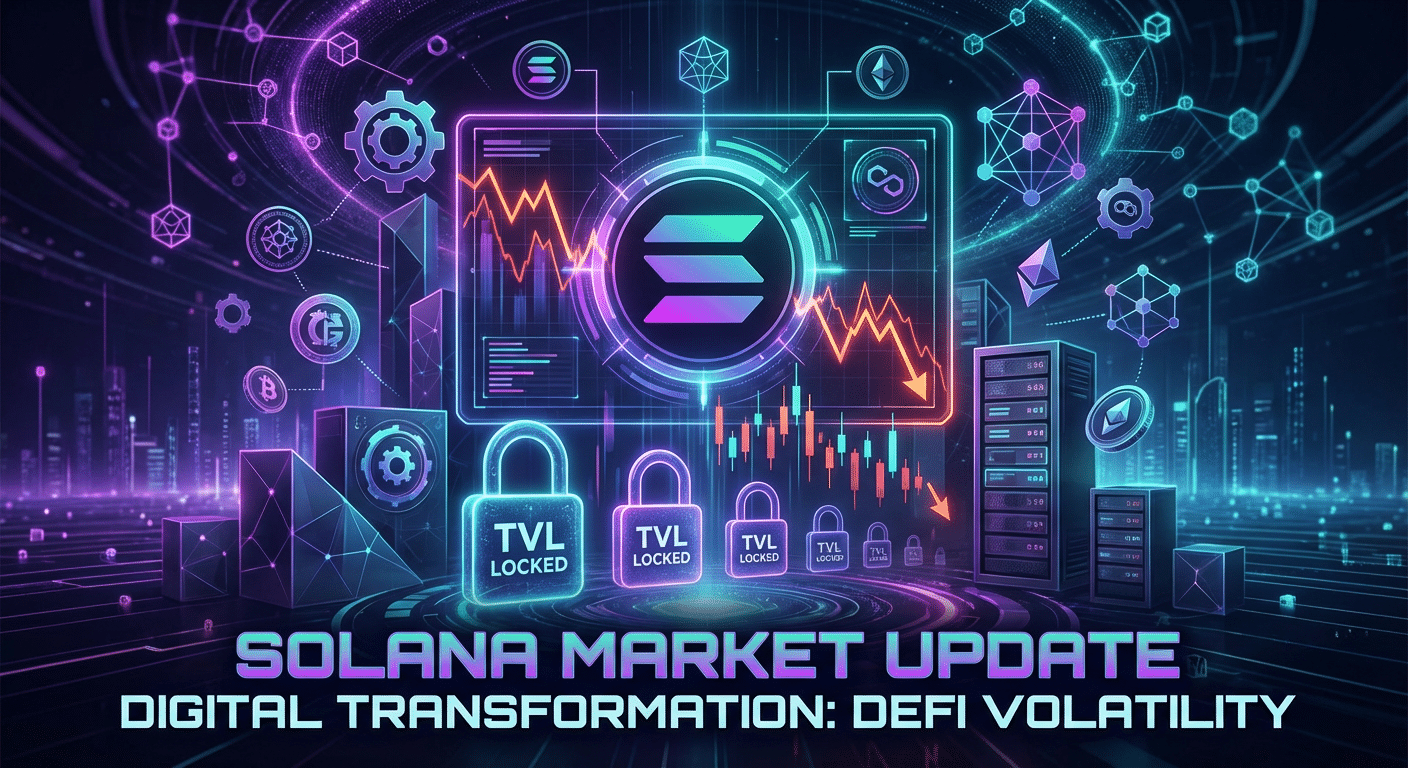
Solana TVL Hits $8.6B Six-Month Lows: Is $80 SOL Price Next? The Crucial Intersection of Market Dynamics and Web3 Innovation
Key Takeaways
- Solana’s Total Value Locked (TVL) has fallen to a six-month low of $8.6 billion, raising questions about the future price trajectory of its native token, SOL, towards potentially $80.
- TVL serves as a vital indicator of a blockchain’s health, reflecting user confidence, liquidity, and the overall adoption of its decentralized finance (DeFi) ecosystem.
- Despite its “Ethereum killer” reputation and technical advantages, Solana’s journey has been marked by significant volatility, influenced by macroeconomic headwinds, regulatory uncertainties, and intense competition.
- Beyond immediate price speculation, Solana’s high-throughput architecture offers substantial benefits for business efficiency in supply chain, cross-border payments, and record-keeping, alongside driving digital transformation in DeFi, Web3 gaming, and asset tokenization.
- Market downturns, while challenging, can present strategic opportunities for businesses to build on foundational Web3 infrastructure, focusing on utility and long-term innovation rather than short-term market fluctuations.
Table of Contents
-
- Understanding Total Value Locked (TVL) and Its Significance
- Solana’s Journey: From “Ethereum Killer” to Market Volatility
- Unpacking the Market Analysis: What Does a Bearish Pattern Signify?
- Connecting Blockchain Solutions to Business Efficiency and Digital Transformation
- Expert Perspectives on Solana’s Trajectory and Blockchain’s Future
- The Path Forward: Resilience, Innovation, and Strategic Vision
- FAQ: Solana TVL and Market Dynamics
- Conclusion
The world of digital assets is in constant flux, a dynamic arena where technological innovation meets volatile market sentiment. In recent headlines, the popular blockchain platform Solana has captured significant attention with its Total Value Locked (TVL) hitting a six-month low of $8.6 billion. This development has sparked vigorous debate across the industry, particularly regarding the potential for Solana’s native token, SOL, to dip further towards the $80 mark. Understanding such market movements is not merely about tracking price charts; it’s about grasping the underlying health of an ecosystem, the broader implications for the blockchain sector, and how these trends inform strategic decisions for business professionals, entrepreneurs, and crypto enthusiasts alike.
This significant dip in Solana’s TVL, coupled with SOL trading 52% lower than its September 18th highs of $255, presents a crucial moment for analysis. As on-chain data and bearish patterns suggest potential further losses for SOL investors, it’s imperative to delve deeper into what these metrics signify, the forces driving such market behavior, and the enduring value proposition of blockchain technology even amidst downward trends. For businesses considering or currently leveraging Web3 solutions, these market fluctuations offer a unique lens through which to assess risk, opportunity, and the long-term viability of decentralized platforms for digital transformation and financial innovation.
Understanding Total Value Locked (TVL) and Its Significance
To fully appreciate the implications of Solana’s recent TVL figures, we must first understand what Total Value Locked (TVL) represents. In the decentralized finance (DeFi) ecosystem, TVL is a critical metric that quantifies the total value of all assets staked, locked, or supplied to a DeFi protocol or an entire blockchain ecosystem. It acts as a barometer for the health, adoption, and liquidity of a blockchain’s DeFi applications. A higher TVL generally indicates greater user confidence, more robust liquidity, and a thriving ecosystem of decentralized applications (dApps). Conversely, a declining TVL often signals reduced user engagement, capital flight, or a general cooling of investor sentiment towards that particular chain or its associated DeFi protocols.
For business professionals, TVL is more than just a number; it’s an indicator of operational capacity and financial innovation. A robust TVL suggests a network capable of handling significant financial throughput, enabling sophisticated lending, borrowing, and exchange mechanisms that can bypass traditional financial intermediaries. This directly relates to the potential for financial innovation and operational optimization. A blockchain with high TVL can support more complex and larger-scale decentralized applications, offering businesses new avenues for capital formation, liquidity management, and even entirely new business models built on fractional ownership or tokenized assets.
When Solana’s TVL drops to a six-month low, it indicates that a substantial amount of capital has been withdrawn from its various DeFi protocols, including decentralized exchanges (DEXs), lending platforms, and staking services. This could be due to a variety of factors: investors taking profits, shifting capital to other chains, concerns over network performance, or simply a broader market downturn impacting all crypto assets. While concerning for short-term price action, a discerning eye will look beyond the immediate dip to understand the underlying causes and the network’s resilience.
Solana’s Journey: From “Ethereum Killer” to Market Volatility
Solana burst onto the blockchain scene with ambitious claims, often touted as an “Ethereum killer” due to its remarkably high transaction throughput, low fees, and innovative proof-of-history (PoH) consensus mechanism coupled with proof-of-stake (PoS). These technical advantages promised a scalable solution to the congestion and high gas fees that plagued other popular blockchains. Its speed and efficiency quickly attracted a vibrant community of developers and investors, leading to a boom in its ecosystem, spanning DeFi, non-fungible tokens (NFTs), and Web3 gaming. Businesses looking for scalable infrastructure to build their dApps or integrate blockchain technology often found Solana an appealing option.
However, Solana’s journey has also been marked by periods of significant volatility and technical challenges. Network outages, though less frequent now, have historically shaken investor confidence. The platform’s rapid growth also meant it became a focal point during broader market corrections. The current decline in TVL and price represents another chapter in this narrative, reflecting a maturing market where even technically superior chains are subject to macro-economic headwinds, regulatory uncertainties, and intense competition.
“While Solana’s speed and efficiency remain impressive, market sentiment is heavily swayed by liquidity. A sustained drop in TVL signals a withdrawal of confidence, prompting a deeper look into both the specific network dynamics and broader market conditions affecting capital allocation.”
– Dr. Evelyn Reed, Blockchain Economist and Senior Market Analyst
Unpacking the Market Analysis: What Does a Bearish Pattern Signify?
The summary article mentions “on-chain data and a bearish pattern suggested that SOL investors risked further losses.” This refers to technical analysis indicators that market analysts use to predict future price movements. A “bearish pattern” could encompass various chart formations such as head and shoulders, descending triangles, or a break below key support levels. When combined with on-chain data – which tracks real-time transactions, wallet activities, and network usage – it provides a more comprehensive picture of market sentiment and potential price trajectory.
For SOL, trading 52% lower than its previous highs indicates a significant correction. The suggestion of a potential $80 SOL price point implies that analysts see strong resistance levels above and weak support below current prices, driven by factors like:
- Macroeconomic Headwinds: Broader economic downturns, rising interest rates, and inflationary pressures often lead investors to de-risk, pulling capital from speculative assets like cryptocurrencies.
- Regulatory Uncertainty: The evolving regulatory landscape for digital assets across different jurisdictions creates an environment of caution for institutional investors and large capital holders.
- Competition: The blockchain space is highly competitive, with numerous Layer-1 and Layer-2 solutions vying for developer talent and user adoption. Shifts in preference can impact TVL and price.
- Network-Specific Concerns: While Solana has made strides in stability, past outages or any perceived vulnerabilities can linger in investor minds, influencing their decisions during market downturns.
- Liquidation Cascades: In a volatile market, large price drops can trigger liquidations of leveraged positions, exacerbating downward price pressure.
For business leaders, understanding these dynamics is crucial. While the immediate focus might be on asset prices, the underlying technology’s value proposition often remains intact. A temporary dip might even present a strategic entry point for businesses looking to invest in or build on these platforms at a lower cost. The resilience of the network and its developer community during these times is a key indicator of its long-term viability.
“The ‘bearish pattern’ isn’t just about lines on a chart; it reflects collective investor psychology. When a major asset like SOL sees its TVL drop this significantly, it signals a deeper re-evaluation of its risk-reward profile, impacting everything from retail sentiment to institutional allocations. Businesses must monitor these shifts for strategic timing.”
– Jonathan Price, CIO of Digital Asset Investment Group
Connecting Blockchain Solutions to Business Efficiency and Digital Transformation
Beyond the immediate market speculation surrounding Solana’s price, the broader implications for business and digital transformation are profound. Regardless of short-term price fluctuations, the fundamental value proposition of high-throughput blockchains like Solana remains a powerful catalyst for innovation.
Business Efficiency
Blockchain technology inherently offers avenues for operational optimization. For businesses, Solana’s characteristics—speed (thousands of transactions per second) and low transaction costs—translate directly into improved efficiency in several key areas:
- Supply Chain Management: Enhanced transparency and traceability from source to consumer. Businesses can track goods in real-time, verify authenticity, and automate payments upon delivery, reducing fraud and delays.
- Cross-Border Payments: Traditional international remittances are slow and expensive. Solana-based payment rails can enable near-instantaneous and significantly cheaper cross-border transactions, benefitting businesses with global operations and those in the remittance industry.
- Record Keeping and Data Integrity: Immutable ledgers provide tamper-proof records for everything from legal documents to intellectual property, reducing auditing costs and increasing trust.
- Tokenization of Assets: Real estate, art, and even company shares can be tokenized on a blockchain like Solana, enabling fractional ownership, increased liquidity, and automated dividend distribution, simplifying complex asset management.
Digital Transformation and Financial Innovation
The integration of blockchain and Web3 technologies is a cornerstone of modern digital transformation strategies, particularly for financial services and technology companies.
- Decentralized Finance (DeFi) for Enterprises: While individual investors participate in DeFi, enterprises can leverage DeFi primitives for new forms of financing, lending, and treasury management. Imagine corporate bonds tokenized on Solana, accessible to a wider pool of investors, or businesses using decentralized lending protocols to access capital more efficiently.
- Web3 Gaming and Metaverse Economies: Solana has been a strong contender for Web3 gaming due to its low transaction fees, which are essential for in-game economies, NFT marketplaces, and play-to-earn models. Businesses in the entertainment, gaming, and virtual goods sectors can tap into entirely new revenue streams and engagement models.
- Identity Management: Decentralized Identity (DID) solutions built on blockchains can empower users with greater control over their personal data, reducing the risk of data breaches for businesses and streamlining Know Your Customer (KYC) processes with verifiable credentials.
- Programmable Money and Smart Contracts: The ability to embed logic directly into transactions through smart contracts on Solana opens up endless possibilities. From automated insurance payouts based on specific conditions to escrow services without intermediaries, smart contracts streamline complex financial and operational agreements, reducing human error and increasing trust.
The fluctuations in SOL’s price or TVL do not diminish the inherent value of the technology. Instead, they highlight the nascent stage of this industry and the importance for businesses to develop robust strategies that account for market volatility while focusing on the long-term benefits of decentralization, transparency, and efficiency. Businesses that understand these underlying technological merits can position themselves to capitalize on the next wave of innovation, irrespective of short-term market sentiment.
Expert Perspectives on Solana’s Trajectory and Blockchain’s Future
The current market correction for Solana has drawn varied responses from industry leaders, emphasizing both caution and long-term optimism.
“Solana’s current TVL decline is a textbook example of how macroeconomic factors can amplify specific network concerns. While its technical architecture remains solid, regaining investor confidence will require consistent network stability and a clear pathway to expanded enterprise adoption beyond speculative DeFi plays.”
– Catherine Zhao, CEO of NextGen Blockchain Ventures
Other experts emphasize the cyclical nature of crypto markets and the potential for a rebound, especially for projects with strong fundamentals.
“Every market downturn culls the weak and strengthens the resilient. Solana’s core technology—its speed and scalability—is still highly valuable. For businesses, this period is less about panic and more about building sustainable applications that leverage these features. The long-term trajectory for high-performance blockchains like Solana, especially in Web3 gaming and payments, remains very positive.”
– Marco Verani, Founder of DeFi Innovation Labs
This dichotomy of views underscores the complexity of the digital asset landscape. While market analysts focus on price and liquidity, technology strategists often maintain a long-term view, emphasizing the foundational shifts that blockchain enables.
The Path Forward: Resilience, Innovation, and Strategic Vision
The situation with Solana’s TVL and potential price dip serves as a powerful reminder that the cryptocurrency market, while revolutionary, is also subject to intense volatility. For business professionals and entrepreneurs, this presents both challenges and opportunities.
Challenges:
- Market Risk: Investing directly in cryptocurrencies or building on platforms whose native tokens are highly volatile introduces significant market risk.
- Reputational Risk: Associating with highly speculative assets can carry reputational risk, especially for traditional businesses.
- Regulatory Uncertainty: The lack of clear, consistent global regulation remains a hurdle for widespread institutional adoption.
Opportunities:
- Innovation at Lower Cost: During bear markets, talent and resources often become more accessible, offering opportunities to build foundational Web3 infrastructure or applications at a lower cost.
- Focus on Utility: Market corrections tend to shift focus from speculation to real-world utility. This pushes developers and projects to deliver tangible value, which is precisely what businesses need.
- Strategic Positioning: Businesses that strategically navigate these periods, perhaps by investing in blockchain infrastructure or developing proof-of-concept dApps, can gain a significant competitive advantage when the market recovers.
For Solana specifically, a path to recovery would likely involve demonstrating continued network stability, fostering an even more diverse and robust ecosystem of dApps, attracting more institutional capital, and potentially delivering on new technological advancements. The long-term success of Solana, and indeed any major blockchain, will hinge not just on its technical prowess but on its ability to solve real-world problems and sustain a vibrant community of users and developers.
FAQ: Solana TVL and Market Dynamics
Q: What is Total Value Locked (TVL) in the context of blockchain?
A: Total Value Locked (TVL) is a key metric in decentralized finance (DeFi) that quantifies the total value of assets staked, locked, or supplied to a DeFi protocol or an entire blockchain ecosystem. It indicates the health, liquidity, and user confidence in a network.
Q: Why is Solana’s recent TVL decline significant?
A: Solana’s TVL hitting a six-month low of $8.6 billion suggests a withdrawal of capital from its DeFi protocols, potentially indicating reduced user engagement, capital flight, or broader market cooling. It raises concerns about SOL’s price trajectory and the ecosystem’s short-term sentiment.
Q: What factors are contributing to SOL’s price volatility?
A: SOL’s price volatility is influenced by macroeconomic headwinds (e.g., inflation, interest rates), regulatory uncertainty, intense competition in the blockchain space, network-specific concerns (like past outages), and liquidation cascades in leveraged positions.
Q: How can businesses leverage Solana’s technology amidst market fluctuations?
A: Businesses can leverage Solana’s speed and low costs for improved efficiency in supply chain management, cross-border payments, and data integrity. It also offers opportunities for digital transformation through enterprise DeFi, Web3 gaming, tokenization of assets, and smart contracts, focusing on the long-term utility despite short-term market dips.
Q: What are the opportunities for innovation during a crypto market correction?
A: Market corrections can present opportunities for innovation at a lower cost due to more accessible talent and resources. They shift focus from speculation to real-world utility, pushing for tangible value. Businesses that strategically invest in infrastructure or build proof-of-concept dApps during these periods can gain a competitive advantage.
Conclusion
In conclusion, while the headline “Solana TVL hits $8.6B six-month lows: Is $80 SOL price next?” undoubtedly grabs attention, it’s merely a snapshot of a much larger, more intricate picture. For business leaders, the takeaway is not simply to track price movements, but to understand the fundamental shifts blockchain technology brings to operational efficiency, financial innovation, and digital transformation. Market corrections are an inherent part of innovation cycles. Those who look beyond the immediate turbulence to the underlying potential of Web3 will be best positioned to harness its transformative power and drive future growth in an increasingly decentralized world. The future of business is intrinsically linked to these technological advancements, and staying informed is the first step towards shaping that future.