



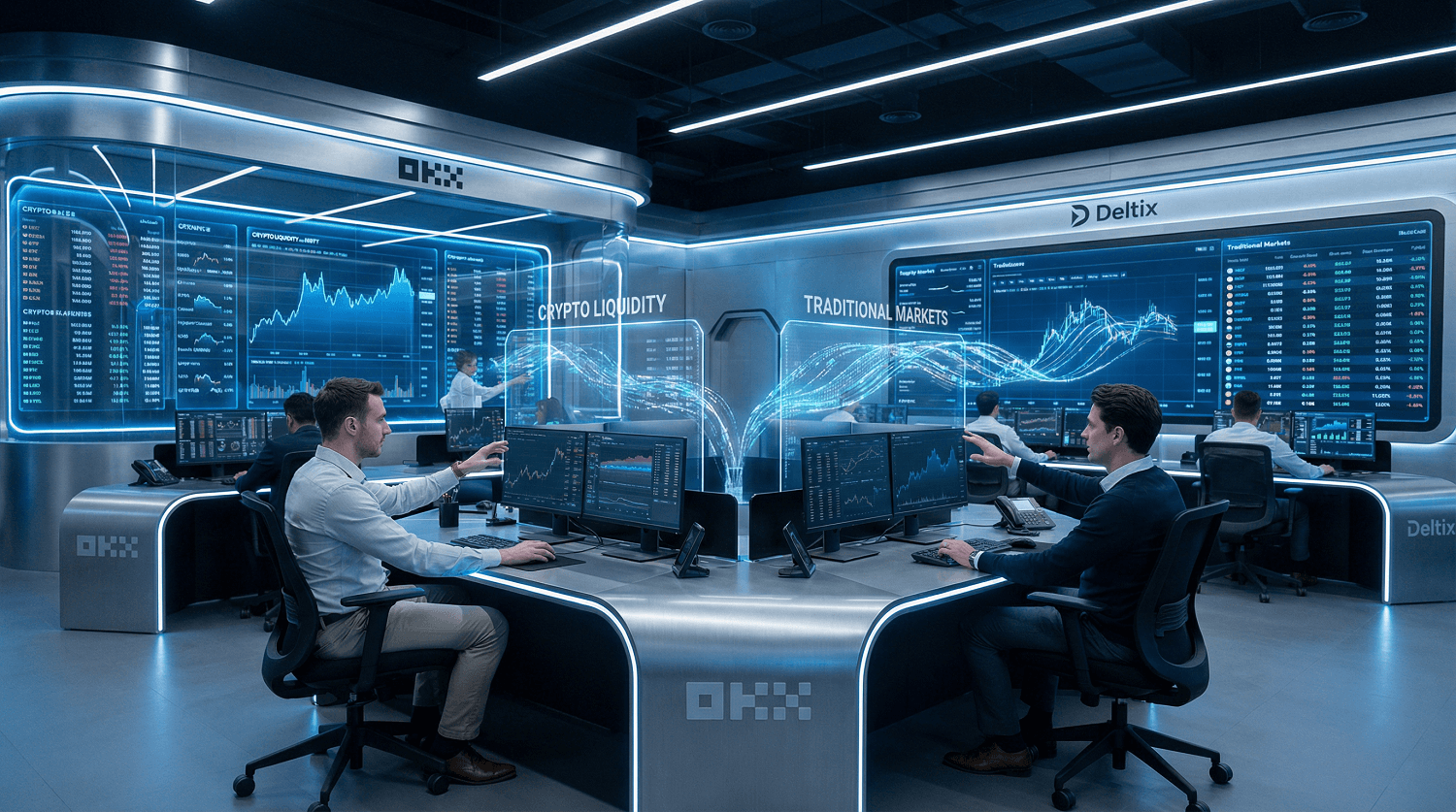
OKX and Deltix Boost US Institutional Trading
Key Takeaways
- OKX and Deltix have partnered to provide US institutions with regulated access to digital asset liquidity via their existing traditional trading infrastructure.
- This collaboration directly addresses major barriers for institutions, including regulatory uncertainty, market fragmentation, and lack of integrated infrastructure.
- The initiative aims to legitimize and streamline digital asset trading, allowing institutions to use familiar systems for crypto alongside equities and FX.
- The partnership is expected to drive business efficiency, foster new financial innovation, and accelerate the digital transformation of financial services.
- It signifies a crucial step towards integrating digital assets seamlessly into the global financial ecosystem, creating new opportunities for growth.
Table of Contents
- The Institutional Imperative: Why Traditional Finance is Turning to Crypto
- Bridging the Gap: The OKX-Deltix Solution for Institutional Access
- The Broader Impact: Digital Transformation and Financial Innovation
- The Role of Blockchain Solutions and Crypto in a Transformed Future
- Looking Ahead: The Future of Institutional Digital Asset Trading
- FAQ
- Conclusion
The landscape of digital assets is rapidly evolving, moving beyond early adopters and retail investors to capture the attention, and increasingly, the active participation of institutional players. In a significant development set to accelerate this trend, OKX and Deltix have joined forces to boost US institutional trading, enabling sophisticated market participants to access regulated digital-asset liquidity through the very same infrastructure they utilize for traditional equities and foreign exchange (FX). This strategic partnership marks a pivotal moment, signaling a maturing market where digital assets are poised for deeper integration into the global financial ecosystem.
For years, the promise of cryptocurrency and blockchain technology has captivated innovators and visionaries. However, for large financial institutions, the leap into this nascent asset class has been fraught with challenges, primarily stemming from regulatory ambiguities, fragmented liquidity, security concerns, and a stark lack of institutional-grade trading infrastructure. The collaboration between OKX, a leading global digital asset exchange, and Deltix, a recognized provider of quantitative research and trading solutions for traditional financial markets, directly addresses these critical pain points, paving a clearer path for institutional capital to flow into the crypto space.
This initiative is not merely about providing access; it’s about legitimizing and streamlining the process for institutions. By offering a familiar and regulated environment, OKX and Deltix are dismantling some of the most significant barriers to entry, fostering an environment where digital assets can be evaluated and traded with the same rigor and confidence as traditional financial instruments. For business professionals, entrepreneurs, and crypto enthusiasts alike, understanding the implications of this move is crucial, as it foreshadows a future where digital assets are seamlessly woven into the fabric of global finance, driving innovation and efficiency across industries.
The Institutional Imperative: Why Traditional Finance is Turning to Crypto
The journey of digital assets from a niche, speculative interest to a recognized, albeit nascent, asset class has been marked by significant volatility and skepticism. Yet, beneath the surface noise, a compelling narrative of innovation, decentralization, and potential financial revolution has steadily drawn the attention of institutional investors. Pension funds, hedge funds, asset managers, and corporate treasuries are increasingly looking at cryptocurrencies like Bitcoin and Ethereum, as well as the broader spectrum of digital assets, for several strategic reasons:
- Diversification: In an increasingly interconnected global economy, traditional asset classes often move in tandem. Digital assets, while sometimes correlated with tech stocks, often exhibit different market dynamics, offering a potential hedge against inflation and a new avenue for portfolio diversification, which is a cornerstone of sound investment strategy.
- Technological Innovation and Growth Potential: Blockchain technology, the foundation of digital assets, represents a fundamental shift in how value is stored, transferred, and managed. Institutions recognize the immense potential of this underlying technology to disrupt various sectors, from finance and logistics to supply chain management and intellectual property. Investing in digital assets is, in part, an investment in this technological future, positioning institutions to capitalize on long-term growth trends.
- Demand from Clients and Beneficiaries: As younger generations, more familiar with digital technologies, accumulate wealth, there’s growing demand for exposure to digital assets within investment portfolios. Institutions are responding to this client-driven imperative to remain competitive and relevant in an evolving financial landscape.
- Inflation Hedge and Store of Value Narrative: Particularly for Bitcoin, the narrative of being “digital gold” – a scarce, decentralized asset resistant to inflationary pressures – has resonated with some institutional investors, especially during periods of quantitative easing and economic uncertainty.
- Efficiency and Transparency: The inherent properties of blockchain—transparency, immutability, and disintermediation—offer tantalizing prospects for greater efficiency and reduced costs in financial operations, especially in cross-border payments and asset settlement.
However, despite these compelling drivers, the actual engagement of institutional capital has been slower than many expected. This lag can be attributed to a confluence of significant hurdles that the traditional financial world is accustomed to mitigating:
- Regulatory Uncertainty: The lack of clear, consistent regulatory frameworks across different jurisdictions has been a primary deterrent. Institutions operate under strict compliance obligations, and the ambiguity around how digital assets are classified and regulated creates significant legal and operational risks.
- Security Concerns and Custody: Managing highly valuable digital assets requires specialized security protocols and robust custody solutions far beyond those typically employed for traditional securities. The threat of hacks, private key loss, and operational errors has necessitated the development of institutional-grade custody services.
- Market Fragmentation and Liquidity: The digital asset market is notoriously fragmented, spread across numerous exchanges globally, each with varying liquidity. This makes efficient price discovery and execution of large institutional orders challenging and often costly, contrasting sharply with the unified, highly liquid markets for equities and FX.
- Lack of Integrated Infrastructure: Traditional financial institutions rely on sophisticated, highly integrated trading systems, risk management platforms, and back-office solutions. Integrating digital assets into these existing workflows has been a monumental task, often requiring custom builds and workarounds, leading to operational inefficiencies and increased costs.
It is precisely these challenges that the OKX and Deltix partnership seeks to overcome, creating a more hospitable environment for institutional capital.
Bridging the Gap: The OKX-Deltix Solution for Institutional Access
The collaboration between OKX and Deltix is designed to be a potent catalyst for institutional adoption, directly addressing the core pain points that have historically hindered large-scale participation. At its heart, the partnership leverages the strengths of both entities: OKX’s deep liquidity and expertise in digital asset trading, combined with Deltix’s established track record in providing institutional-grade trading technology for traditional markets.
The crux of their offering to US institutional clients is twofold: access to regulated digital-asset liquidity and integration via existing infrastructure used for equities and FX. This combination is a game-changer for several reasons:
Regulated Digital-Asset Liquidity
For institutions, “regulated” is not just a buzzword; it’s a fundamental requirement. It signifies a commitment to legal compliance, investor protection, and operational integrity.
- Regulatory Compliance: Accessing regulated liquidity means interacting with platforms that adhere to Anti-Money Laundering (AML) and Know Your Customer (KYC) regulations, licensed operational standards, and potentially capital requirements. This mitigates legal and reputational risks for institutions, allowing them to participate in the crypto market within established compliance frameworks.
- Market Integrity: Regulated environments often come with surveillance mechanisms designed to detect and prevent market manipulation, ensuring fairer and more transparent trading conditions. This builds trust and confidence, essential for large-scale institutional engagement.
- Risk Mitigation: Operating within a regulated framework provides a level of certainty and protection that is absent in unregulated markets. This includes protections against operational failures, security breaches, and counterparty risks, all vital for fiduciary duties.
Expert Take: Regulatory Navigator
“The institutional floodgates for digital assets won’t fully open until robust regulatory clarity is pervasive. Partnerships like OKX and Deltix, which emphasize regulated access, are crucial steps in building the necessary trust and compliance infrastructure that traditional finance demands before committing significant capital.”
– Dr. Eleanor Vance, Head of Digital Asset Compliance Strategy, Fincorp Solutions
Leveraging Existing Infrastructure
This is perhaps the most significant operational advantage for institutions. Instead of forcing them to adopt entirely new systems and workflows, the OKX-Deltix integration allows them to use the trading infrastructure they already know and trust.
- Seamless Integration: Institutions have invested heavily in sophisticated trading platforms (like Deltix’s) for equities, FX, and other traditional assets. By connecting OKX’s digital asset liquidity to these existing systems, firms can add crypto trading capabilities without undergoing a costly and complex overhaul of their tech stack. This reduces implementation time and capital expenditure.
- Operational Efficiency: Traders and portfolio managers can utilize their familiar interfaces, execution algorithms, and risk management tools for digital assets, just as they do for other asset classes. This eliminates the need for extensive retraining, reduces operational errors, and streamlines workflows, leading to significant efficiency gains.
- Unified Risk Management: Integrating digital asset trading into existing infrastructure allows for a holistic view of portfolio risk across all asset classes. Institutions can apply their established risk models, real-time monitoring, and compliance checks to their crypto exposure, which is critical for maintaining overall portfolio integrity and meeting regulatory mandates.
- Reduced Learning Curve: For institutional traders and analysts, the learning curve associated with a new asset class is steep enough. Providing access through familiar tools dramatically reduces the cognitive load and allows them to focus on market analysis and strategy rather than navigating new systems.
The Broader Impact: Digital Transformation and Financial Innovation
The OKX-Deltix partnership extends beyond just facilitating trading; it represents a significant stride in the broader digital transformation of financial services and is a catalyst for financial innovation.
Business Efficiency and Operational Optimization
The ability to access regulated digital asset liquidity via existing TradFi infrastructure directly translates to unparalleled business efficiency. Firms can:
- Reduce IT Costs: Avoid the expense of developing or acquiring entirely new, bespoke crypto trading systems.
- Streamline Workflows: Integrate digital assets into existing order management, execution, and post-trade processing systems, minimizing manual intervention and reconciliation.
- Enhance Risk Management: Centralize risk monitoring across all asset classes, leading to better capital allocation and reduced exposure to unforeseen market movements.
- Improve Decision-Making: With integrated data feeds and analytics, institutions can gain a more comprehensive, real-time view of their entire portfolio, enabling quicker and more informed trading decisions.
This operational optimization isn’t just about cutting costs; it’s about enabling institutions to respond with agility to market opportunities and client demands in the rapidly evolving digital asset space.
Financial Innovation and New Business Models
The presence of regulated, integrated institutional liquidity opens the door to a new wave of financial innovation:
- Sophisticated Trading Strategies: With familiar tools, quantitative funds and algorithmic traders can apply their advanced models and high-frequency strategies to digital assets, potentially leading to more efficient price discovery and reduced market volatility.
- Development of New Products: As confidence grows, institutions can develop new crypto-linked financial products, such as structured products, derivatives, and exchange-traded funds (ETFs), that cater to a broader range of investors. This expands the market for digital assets beyond direct spot trading.
- Cross-Asset Arbitrage and Hedging: The seamless integration allows for more effective cross-asset arbitrage opportunities and hedging strategies between digital assets and traditional financial instruments, contributing to market maturation.
- Leveraging Web3 Technologies: While the partnership focuses on existing assets, the infrastructure laid down is foundational for integrating future Web3 innovations. Institutions using these systems are better positioned to explore tokenized real-world assets, decentralized finance (DeFi) protocols, and other blockchain-native financial applications as they mature and become more regulated. This sets the stage for a future where traditional finance and Web3 are increasingly intertwined, driving new paradigms in asset ownership, transfer, and management.
Expert Take: Digital Transformation Catalyst
“True digital transformation in finance isn’t just about digitizing existing processes; it’s about leveraging new technologies to create entirely new capabilities. The OKX-Deltix alliance exemplifies this by bridging the chasm between traditional trading desks and the digital asset economy, setting a precedent for how Web3 components will integrate into mainstream finance.”
– Professor Benjamin Chen, Director of FinTech Innovation Lab, Global University of Economics
The Role of Blockchain Solutions and Crypto in a Transformed Future
At the core of these developments lies blockchain technology and the digital assets it underpins. The partnership between OKX and Deltix inherently highlights the critical ways blockchain solutions and cryptocurrencies are reshaping the financial world:
- Disintermediation and Efficiency: Blockchain’s ability to facilitate peer-to-peer transactions without intermediaries dramatically reduces transaction costs and settlement times. While institutional trading platforms still involve intermediaries, the underlying assets benefit from these efficiencies, which can eventually trickle up to impact overall market structure.
- Transparency and Immutability: The transparent and immutable nature of public blockchains means that every transaction is recorded permanently and publicly (or cryptographically verifiable), enhancing auditability and reducing fraud. For regulated institutions, this offers a new level of data integrity.
- Fractional Ownership and Liquidity: Blockchain enables the fractionalization of assets, which can unlock liquidity for illiquid assets and democratize access to investment opportunities that were previously restricted due to high capital requirements.
- Programmable Money and Smart Contracts: Cryptocurrencies are not just digital currencies; many are programmable. Smart contracts, self-executing contracts with the terms of the agreement directly written into code, can automate complex financial operations, reducing operational risk and increasing efficiency in areas like derivatives, escrows, and automated market making.
- Global Access and Inclusivity: Blockchain-based digital assets transcend geographical boundaries, facilitating global capital flows and offering financial services to underserved populations worldwide. As institutions embrace these assets, they tap into a truly global market.
The OKX-Deltix partnership is a testament to the ongoing maturation of the digital asset industry, showcasing how key players are building the necessary infrastructure to integrate this innovative technology into mainstream finance. It underscores that for crypto to realize its full potential, it must meet the stringent requirements of the traditional financial system while retaining its inherent advantages.
Looking Ahead: The Future of Institutional Digital Asset Trading
The collaboration between OKX and Deltix is more than just a new product offering; it’s a significant milestone in the journey of digital assets toward mainstream institutional acceptance. By meticulously addressing the critical concerns of regulation, security, and infrastructure integration, they are paving the way for a more robust, liquid, and mature digital asset market.
The implications for business professionals and entrepreneurs are profound. As digital assets become more accessible and integrated into traditional financial systems:
- New Investment Opportunities: The increased liquidity and regulatory clarity will attract more capital, leading to a wider array of investment opportunities in the digital asset space.
- Evolving Business Models: Financial institutions and corporations will increasingly explore tokenization of assets, blockchain-based financing, and other innovative business models enabled by this foundational shift.
- Demand for Expertise: There will be a growing demand for professionals who understand both traditional finance and the intricacies of blockchain technology and digital assets.
- Global Financial Integration: The seamless flow of capital between traditional and digital asset markets will further blur the lines, leading to a more integrated and efficient global financial system.
Expert Take: Market Evolution Predictor
“This partnership is a clear signal that the institutional ‘wait and see’ approach is evolving into active engagement. What we’re witnessing is the scaffolding being built for a multi-trillion-dollar digital asset economy, where sophisticated market participants operate within frameworks they know and trust, propelling crypto into its next growth phase.”
– Michael Vance, Senior Analyst, Digital Asset Research Institute
The move by OKX and Deltix to boost US institutional trading is a powerful indicator of where the industry is headed. It signals a future where digital assets are not merely an alternative, but an integral component of a modernized, digitally transformed global financial landscape, driving efficiency, innovation, and unprecedented opportunities for growth across the business world. The journey is far from over, but with such strategic alliances, the path forward for institutional crypto adoption is becoming clearer and more compelling than ever before.
FAQ
What is the OKX and Deltix partnership about?
The partnership between OKX, a leading digital asset exchange, and Deltix, a provider of traditional finance trading solutions, aims to facilitate US institutional access to regulated digital asset liquidity. It allows institutions to trade digital assets using their existing infrastructure for equities and FX.
Why are institutions increasingly interested in digital assets?
Institutions are drawn to digital assets for portfolio diversification, the technological innovation and growth potential of blockchain, growing client demand, the inflation hedge narrative (especially for Bitcoin), and the prospects of increased efficiency and transparency.
What challenges does this partnership address for institutional trading?
The partnership directly tackles regulatory uncertainty, security concerns and custody issues, market fragmentation, and the lack of integrated infrastructure that have historically deterred institutional entry into the digital asset market.
How does leveraging existing infrastructure benefit traditional financial institutions?
It offers seamless integration, operational efficiency by using familiar tools, unified risk management across asset classes, and a reduced learning curve for traders, ultimately cutting costs and streamlining workflows.
Conclusion
The strategic alliance between OKX and Deltix represents a landmark development in the digital asset landscape, specifically designed to empower US institutional traders. By providing regulated access and integrating with existing traditional finance infrastructure, this partnership is not just easing market entry but actively shaping a future where digital assets are a seamless and indispensable part of the global financial system. This collaboration paves a clearer, more confident path for institutional capital into crypto, fostering innovation, efficiency, and significant growth opportunities across the financial world.