




Solana Price Prediction: Institutions Pile In as Staking Hits 3.1M SOL – Could SOL Overtake Bitcoin in 2026?
Key Takeaways
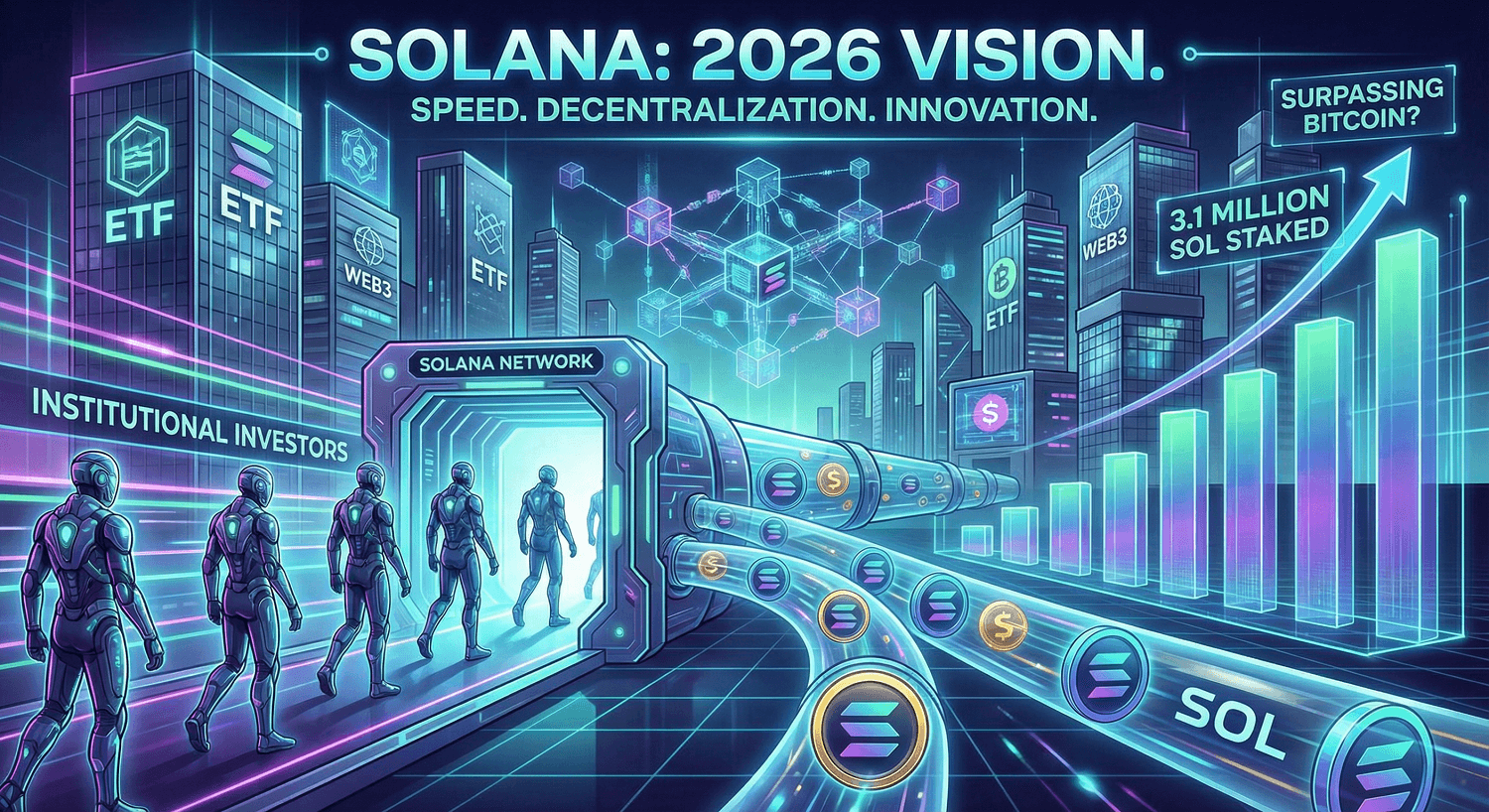
- Institutional Influx: Major financial players are increasingly investing in Solana, spurred by sophisticated products like Spot SOL Staking ETFs, signaling a maturation of the digital asset market.
- Network Strength: A substantial 3.1 million SOL being staked demonstrates strong long-term conviction and significantly enhances Solana’s network security and decentralization.
- Ambitious Forecasts: Solana’s unparalleled transaction speeds, low fees, and growing Web3 ecosystem lead to bold predictions of it potentially surpassing Bitcoin by 2026.
- Business Opportunities: Solana offers compelling avenues for businesses to achieve enhanced efficiency, drive digital transformation, and pioneer financial innovation through its high-performance blockchain infrastructure.
Table of Contents
- The Institutional Onslaught: Spot SOL Staking ETFs and Market Maturation
- The Power of Staking: 3.1 Million SOL and Network Health
- The Audacious Claim: Could SOL Overtake Bitcoin in 2026?
- Connecting Solana to Business Efficiency, Digital Transformation, and Financial Innovation
- FAQ Section
- The Road Ahead (Conclusion)
The digital asset landscape is in a perpetual state of flux, characterized by rapid innovation, shifting market dynamics, and the constant emergence of technologies that challenge the status quo. Among the most compelling narratives currently unfolding is the remarkable rise of Solana, a blockchain platform that has captured the attention of both retail investors and, increasingly, major institutional players. The latest buzz centers around a bold Solana price prediction: institutions are piling in as staking hits a staggering 3.1 million SOL, leading some to question if Solana could indeed overtake Bitcoin in 2026. This ambitious forecast underscores Solana’s burgeoning influence and its potential to redefine the hierarchies within the cryptocurrency market. For business professionals, entrepreneurs, and crypto enthusiasts, understanding the forces driving Solana’s ascent is crucial for navigating the next wave of digital transformation and financial innovation.
Solana’s journey from a promising startup to a formidable competitor in the Layer 1 blockchain space has been nothing short of meteoric. Its architectural design, boasting unparalleled transaction speeds and significantly lower fees compared to many of its peers, positions it as a viable backbone for a wide array of decentralized applications (dApps), from DeFi protocols and NFT marketplaces to enterprise-grade solutions. This technical prowess is a foundational element attracting capital and talent, laying the groundwork for its expansion and deepening its integration into the global digital economy. The increasing institutional engagement, particularly through mechanisms like Spot SOL Staking ETFs, signals a critical juncture, indicating a maturation of the market and a growing acceptance of alternative digital assets beyond Bitcoin.
The Institutional Onslaught: Spot SOL Staking ETFs and Market Maturation
The term “institutional pile-in” is not mere hyperbole; it represents a tangible shift in how established financial entities view and interact with the crypto market. For years, Bitcoin stood as the sole digital asset commanding significant institutional interest, often seen as a digital store of value akin to gold. However, the advent of sophisticated financial products like Spot SOL Staking ETFs has broadened this scope considerably.
What are Spot SOL Staking ETFs?
A Spot SOL Staking ETF is an exchange-traded fund that holds actual Solana (SOL) tokens and actively stakes them on the Solana network. This innovative product offers institutions a regulated and familiar avenue to gain exposure to Solana’s price movements while simultaneously participating in the network’s security and earning staking rewards, all without the complexities of direct crypto custody and staking management. For a traditional financial institution, such an instrument is a game-changer. It provides the necessary regulatory oversight, liquidity, and operational simplicity that direct cryptocurrency investment often lacks.
Expert Take:
“The introduction of Spot SOL Staking ETFs is a watershed moment for institutional adoption. It bridges the gap between traditional finance and the high-growth potential of Web3, offering a regulated pathway for large-scale capital to flow into performance-oriented blockchains like Solana. This institutional validation is critical for the long-term sustainability and growth of the digital asset class beyond Bitcoin.” – Crypto Market Analyst
The implications of this institutional embrace are profound. Firstly, it injects significant capital into the Solana ecosystem, bolstering its liquidity and market capitalization. Secondly, it lends immense credibility to Solana, signaling to the broader financial world that SOL is not merely a speculative asset but a legitimate component of a diversified investment portfolio. This legitimacy, in turn, can catalyze further investment, driving a virtuous cycle of growth and adoption. For businesses exploring digital transformation, the stability and credibility brought by institutional capital can reduce perceived risks associated with leveraging blockchain technology, making it a more attractive option for integrating Web3 solutions into existing operations.
The Power of Staking: 3.1 Million SOL and Network Health
Central to the narrative of Solana’s potential is the substantial amount of SOL being staked on its network, now reportedly exceeding 3.1 million SOL. Staking is a fundamental mechanism in Proof-of-Stake (PoS) blockchains like Solana, enabling network participants to “lock up” their tokens to support the network’s operations and security. In return, stakers earn rewards, typically in the form of newly minted tokens or transaction fees.
Why is 3.1 Million SOL Staked Significant?
- Network Security: A higher amount of staked SOL indicates a more decentralized and secure network. It makes it exponentially more expensive and difficult for a malicious actor to gain enough control (51% attack) to compromise the network.
- Long-Term Conviction: When individuals and institutions stake their SOL, they are committing their assets for a period, often with unbonding periods that can range from days to weeks. This demonstrates a strong long-term conviction in Solana’s future and its underlying technology.
- Reduced Circulating Supply: Staking effectively removes a portion of the circulating supply from the open market, which can, in theory, contribute to price appreciation if demand remains constant or increases.
- Ecosystem Engagement: Staking encourages active participation in the network’s governance and maintenance, fostering a healthier and more engaged community.
Expert Take:
“The robust staking activity on Solana underscores deep confidence from its community and institutional participants alike. Over 3 million SOL staked isn’t just a number; it reflects the collective belief in Solana’s technical resilience and its roadmap for expanding Web3 use cases. This commitment from stakers is a crucial indicator of the network’s long-term health and its ability to attract and retain value.” – Blockchain Protocol Researcher
For businesses, the concept of staking highlights the collaborative and incentivized nature of blockchain networks. It exemplifies how participants are aligned with the network’s success, contributing to its stability and security – crucial factors when considering blockchain for critical business operations such as supply chain management, data integrity, or secure financial transactions. The efficiency gains and enhanced security offered by well-maintained PoS networks can be transformative for operational optimization.
The Audacious Claim: Could SOL Overtake Bitcoin in 2026?
The prospect of Solana surpassing Bitcoin in market capitalization by 2026 is a bold and contentious prediction, sparking intense debate across the crypto sphere. To assess the feasibility of such a scenario, it’s essential to understand the distinct roles and value propositions of both assets.
Bitcoin: Digital Gold and Store of Value
Bitcoin remains the undisputed king of cryptocurrency, primarily functioning as a decentralized, censorship-resistant store of value. Its strength lies in its simplicity, robust security, and the network effect built over more than a decade. Bitcoin’s narrative is one of scarcity (capped at 21 million coins) and its role as a hedge against inflation and traditional financial instability. Its blockchain, while slower and more expensive for transactions, is unmatched in terms of decentralization and immutability, making it the preferred choice for long-term wealth preservation.
Solana: The High-Performance Blockchain for Web3 Innovation
Solana, in contrast, is designed for speed, scalability, and low-cost transactions, making it an ideal platform for high-throughput applications that demand near-instant finality. It aims to be the foundational layer for Web3, supporting everything from decentralized finance (DeFi) and non-fungible tokens (NFTs) to gaming, social media, and enterprise solutions. Solana’s vision is to onboard billions of users to the blockchain, powering the next generation of internet applications.
Factors Potentially Driving Solana’s Ascent:
- Scalability and User Experience: Solana’s technical superiority in terms of transactions per second (TPS) and low fees offers a vastly superior user experience for everyday applications, which could drive mainstream adoption at a pace Bitcoin cannot match for transactional use cases. This directly translates to business efficiency for dApp developers and users.
- Ecosystem Growth: A vibrant and rapidly expanding ecosystem of dApps, developer tools, and community initiatives can fuel organic demand for SOL. As more innovative projects choose Solana as their home, the utility and value proposition of SOL naturally increase.
- Energy Efficiency: Solana’s Proof-of-History (PoH) consensus mechanism, combined with PoS, is significantly more energy-efficient than Bitcoin’s Proof-of-Work (PoW). In an increasingly environmentally conscious world, this could become a significant competitive advantage and a differentiator for businesses seeking sustainable blockchain solutions.
- Institutional Use Cases Beyond Store of Value: While Bitcoin serves as digital gold, Solana’s capabilities extend to financial innovation through DeFi, digital identity, tokenized real-world assets, and streamlined cross-border payments. Institutions might view SOL as an investment in the future of transactional blockchain infrastructure, leading to broader adoption and integration into existing financial systems. This connects directly to driving digital transformation in finance and beyond.
Expert Take:
“While challenging Bitcoin’s supremacy is an enormous task, Solana’s focus on high throughput and low costs positions it uniquely for mass adoption in Web3. If the next wave of internet innovation is built on blockchain, platforms like Solana are engineered to capture significant market share, potentially redefining the metrics by which ‘value’ in crypto is measured, moving beyond just store-of-value to widespread utility.” – Web3 Economist
Challenges and Realities:
Despite its potential, Solana faces significant hurdles. Bitcoin’s network effect, brand recognition, and unparalleled security are deeply entrenched. Regulatory uncertainty, past network outages (though increasingly rare and mitigated), and intense competition from other Layer 1 blockchains are all factors that could impede Solana’s trajectory. Overtaking Bitcoin would require an unprecedented convergence of technological adoption, sustained institutional investment, and global regulatory clarity, alongside Bitcoin stagnating in its market cap relative to SOL’s explosive growth.
Connecting Solana to Business Efficiency, Digital Transformation, and Financial Innovation
The rise of Solana, propelled by institutional interest and robust staking, offers compelling opportunities for businesses looking to embrace the future of digital assets and Web3.
- 1. Enhanced Business Efficiency: Solana’s high transaction throughput and minimal fees dramatically reduce the operational costs and time associated with blockchain transactions. For businesses engaged in micro-payments, supply chain tracking, loyalty programs, or gaming, this translates into immediate cost savings and improved efficiency. Imagine real-time settlement for complex supply chains or near-instant payments for gig economy workers, all at a fraction of traditional costs.
- 2. Driving Digital Transformation: Businesses can leverage Solana to digitize existing assets, create new digital products, and streamline internal processes. The tokenization of real-world assets (RWAs) on Solana, for instance, can unlock liquidity, enable fractional ownership, and democratize access to investments previously reserved for the wealthy. This represents a significant leap in digital transformation, creating new business models and revenue streams.
- 3. Pioneering Financial Innovation: Solana’s ecosystem is a hotbed of decentralized finance (DeFi) innovation. From lending and borrowing protocols to decentralized exchanges and stablecoin solutions, Solana offers the infrastructure for developing next-generation financial products and services. Institutions can explore using Solana for secure, transparent, and efficient cross-border payments, reducing reliance on slow and expensive legacy systems, thereby fostering true financial innovation.
- 4. Operational Optimization through Decentralization: By integrating Solana-based solutions, businesses can achieve greater operational transparency, immutability of records, and reduced reliance on centralized intermediaries. This can lead to optimized auditing processes, enhanced data security, and a more resilient operational framework, critical in today’s interconnected global economy. For example, decentralized identity solutions on Solana could simplify KYC/AML processes while improving user privacy.
FAQ Section
What is Solana and why is it attracting institutional interest?
Solana is a high-performance blockchain platform known for its unparalleled transaction speeds and low fees. It’s attracting institutional interest due to its technical prowess, robust ecosystem for dApps, and the introduction of regulated financial products like Spot SOL Staking ETFs, which provide a familiar and secure entry point for large investors.
How do Spot SOL Staking ETFs work?
Spot SOL Staking ETFs are exchange-traded funds that hold actual Solana (SOL) tokens and stake them on the Solana network. This allows institutions to gain exposure to SOL’s price movements and earn staking rewards through a regulated vehicle, bypassing the complexities of direct crypto custody and staking.
Why is 3.1 million SOL staked significant for the network?
Over 3.1 million SOL staked signifies enhanced network security, as it becomes harder for malicious attacks. It also indicates strong long-term conviction from stakers, reduces the circulating supply, and fosters a more engaged community, all contributing to the network’s overall health and value.
Could Solana really overtake Bitcoin by 2026?
This is a bold prediction. While Solana’s scalability, energy efficiency, and growing Web3 ecosystem present strong arguments for its ascent as a utility blockchain, Bitcoin’s established role as a digital store of value and its immense network effect pose significant challenges. Overtaking Bitcoin would require sustained growth and widespread adoption far beyond current levels, alongside potential stagnation in Bitcoin’s market cap.
How can businesses leverage Solana for efficiency and innovation?
Businesses can leverage Solana’s high throughput and low fees for enhanced operational efficiency in areas like micro-payments and supply chain tracking. It also enables digital transformation through asset tokenization and pioneers financial innovation via DeFi. Solana offers opportunities for optimized auditing, enhanced data security, and a more resilient operational framework.
The Road Ahead
The narrative around Solana—its institutional adoption, robust staking, and ambitious predictions—underscores a pivotal moment in the evolution of digital assets. While the idea of Solana eclipsing Bitcoin by 2026 remains a subject of intense debate and speculation, the underlying trends are undeniable. Solana is cementing its position as a leading force in the Web3 movement, attracting significant capital and developer talent, and demonstrating its capacity to host a new generation of high-performance decentralized applications.
For business leaders and innovators, the key takeaway is not just about price predictions, but about recognizing the profound impact that highly scalable and efficient blockchains like Solana are having on the global economy. These platforms are not merely speculative assets; they are foundational technologies driving digital transformation, enabling new forms of financial innovation, and offering unprecedented opportunities for operational optimization. As institutions continue to pour capital into structured products like Spot SOL Staking ETFs, they are validating not just Solana as an investment, but the entire paradigm shift towards a more decentralized, efficient, and interconnected digital future. Whether SOL ultimately “flips” Bitcoin or not, its trajectory undeniably positions it as a critical player in shaping the financial and technological landscape for years to come.